Multiple Choice
Multiple Choice challenges are only available on Hosted CTFd instances or with the purchase of the Multiple Choice CTFd plugin
Multiple choice challenges allow users to select a single flag from a list of choices, or several flags when a question has more than one correct answer.
Within the description message you can insert choices for your multiple choice question using the following syntax:
* () Choice 1
* () Choice 2
* () Choice 3
You can then copy the correct choice as a flag.
For example with the following description you will get something like the below image.
* () The Cake
* () 42
* () The Red Umbrella
* () All of the above

How to Create a Multiple Choice Challenge
In order to create a challenge you must be an admin.
Create a challenge and select multiple_choice in the Challenge Types section.

Enter the Name and Category of your challenge.

Enter the Message of your challenge in the text box, and add multiple choices by prefixing each choice with
* ().
Set the number of points that users will receive for answering correctly, and click Create.

Set the flag to the correct answer and set the State to Visible. Click Finish to create the challenge.

Set the maximum attempts for the challenge, if applicable.
Multiple Correct Answers
By default, a multiple choice challenge has a single correct answer and users pick one choice. If a question has more than one correct answer, you can let users select several choices by changing the challenge's Logic to Require All Flags.
Write the choices in the Message of your challenge as usual.
Which of the following are prime numbers?

* () 2
* () 4
* () 7
* () 9
Open the challenge in the admin panel and set Logic to Require All Flags. Click Update to save.

In the Flags tab, create a static flag for every correct choice.

Users will now see checkboxes instead of radio buttons and can select as many choices as they like.
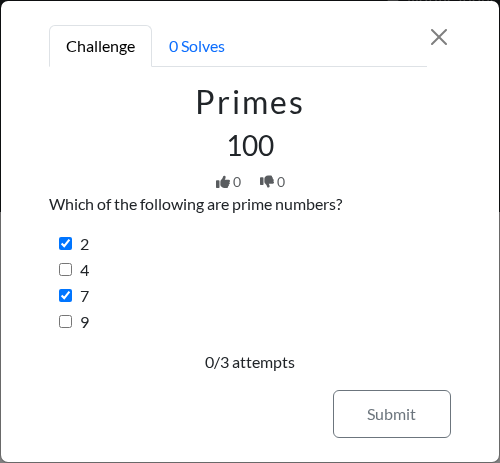
The challenge is only solved when the user selects exactly the correct choices. Missing a correct choice or selecting an incorrect one counts as an incorrect attempt, and users are not told which of their choices were right or wrong.